HYPHEN DIARIES

Hands applying face serum in skincare routine — Hyphen guide for Indian skin types

How to Use Face Serum: Complete Guide for Indian Skin (2026)

Small drops, big results

A face serum is a lightweight skincare product with concentrated active ingredients designed to target specific skin concerns. To use it, apply 2–3 drops on clean, slightly damp skin before your moisturizer and gently press it in. For Indian skin exposed to daily sun, humidity, and pollution, a face serum helps actively target tanning, pigmentation, dullness, and dehydration in a way basic skincare steps often cannot. 

Index

  1. Introduction
  2. What Does Face Serum Do?
  3. Do I Need a Face Serum?
  4. How to Use Face Serum
  5. What Are the Benefits of Face Serum for Indian Skin?
  6. Serum vs Moisturizer vs Toner vs Essence: What's the Difference?
  7. What is The Best Face Serum for Indian Skin?
  8. Which Face Serum Should Beginners in India Use?
  9. FAQ

Face serums come into most people's lives in a very similar fashion: long nights of cleansing and moisturizing, skin that looks fine but not exceptional, and then a serum that subtly transforms everything within a matter of weeks. No magic here, just a smarter way of delivering to your skin what it really needs.

If you've ever wondered how to use face serum, how to apply it, or if you should be using one at all, you've come to the right place. Application is simple: a few drops on damp skin, gently massaged in before your moisturizer. Done. It is as important to know the right serum that suits your skin as knowing how to apply face serums.

Since Indian skin endures so much from exposure to the sun, pollution, and extreme humidity conditions day after day, serums usually help with reducing the effects of these conditions. Here's your guide on face serums, including what does face serum do, how to pick one, and whether you actually need it.


What Does Face Serum Do?

Your cleanser should be thought of as the first step, while your moisturiser is the last step. In between them comes the face serum, which cannot be replaced by either product because it addresses a particular issue.

From discoloration to dullness to dehydration to an uneven skin complexion, the serum provides a concentrated solution in the form of potent actives suspended in a quick-absorbing, thin base that reaches further into the skin than the typical thick cream does. If you have ever asked yourself what does face serum do that your other products cannot, this is the answer.

Active ingredients commonly used in serums and what they do:

  • Vitamin C - Reduces melanin synthesis and lightens existing dark spots. According to a review published in the Journal of Clinical and Aesthetic Dermatology, topical application of vitamin C improves skin tone and mitigates photodamage caused by UV exposure.
  • Hyaluronic Acid - Attracts moisture from the surrounding air and traps it within the skin cells. According to research published on PubMed, topical application of hyaluronic acid leads to a 96% increase in skin moisture content over the course of eight weeks of regular use.
  • Niacinamide - It works in a holistic way: reducing pigmentation, controlling sebum production, and improving the skin barrier to protect against environmental factors.
  • Alpha Arbutin - It focuses on hyperpigmentation and uneven skin tone, blocking the production of melanin.
  • Peptides - They stimulate collagen production in the skin for better elasticity and firmness.

None of them is a new ingredient. Each one has been scientifically proven, and all of them work perfectly with Indian skin.


Do I Need a Face Serum?

To be honest, not everybody needs one.

If your current skincare regime includes a cleanser and moisturiser combination and works perfectly without leaving your skin dull, dry, or patchy, then there isn't a critical need for including a face serum in your regime.

However, if some of these apply to you, then a serum is what you've been missing out on all along:

  • Your skin is often dull despite using a good moisturising cream every day

  • Your skin takes too long to fade sun tan or dark spots

  • Your acne marks don't seem to leave your face after all

  • Your skin often feels parched regardless of the weather conditions

  • Your regime hasn't produced results for a long while

The reason why a regular regime doesn't get you far is that moisturizers aren't potent enough to work deep down into the skin layers to correct these problems. So if you have been asking do I need a face serum, the answer almost always comes down to whether your current routine is actually solving your concerns or just maintaining them.


How to Use Face Serum

Most people either overthink this step or apply it incorrectly, which leads to decreased efficacy. Knowing how to use face serum correctly makes more of a difference than most people realise.

Proper Steps for Application:

  1. Start with cleansing - Whatever is on the surface of your skin will become a barrier between the product and your skin, so make sure it's clean.
  2. Apply to damp skin - Don't give yourself enough time for your skin to be completely dry before application. Damp skin will increase the efficacy of the product.
  3. Use 2-3 drops - Take 2-3 drops of serum on your fingertips.
  4. Press and pat, don't rub - Gently pressing the serum into your skin allows for better absorption than rubbing it.
  5. Wait for 30-60 seconds - Give the serum a moment to settle before applying other products.
  6. Moisturiser - This step locks in the active ingredients and maintains your skin barrier.
  7. SPF - If there are brightening or exfoliating actives, like AHAs or BHAs, in your serum, SPF is necessary. Otherwise, sun exposure would nullify all of the effects.

Two things to note when considering common Indian skin issues:

  • Vitamin C and niacinamide serums are ideal for hyperpigmentation and tanning problems.

  • In cases where dehydration occurs due to excessive heat or air conditioning, the best choice will be hyaluronic acid.

It takes time for the effect of a serum to manifest itself. It takes at least four to six weeks for one to determine whether the product is effective.


What Are the Benefits of Face Serum for Indian Skin?

There are specific problems that are unique to Indian skin which are often overlooked by most generic skincare information on the web. First, Indian skin contains higher concentrations of melanin, which makes the development and removal of hyperpigmentation quicker. There is constant exposure to sunlight all year round, which leads to tanning and other sun-related skin damage. That’s the reason you need to understand the specific benefits of serums for Indian skin.

Here are some reasons why serums would be good for us:

  • They remain lightweight despite humidity - Thicker creams can become suffocating to use during the Indian summer. Serums are absorbed quickly without adding any kind of heaviness or clogging pores, making it easier for us to use serums regularly despite having oily or combination skin.
  • They tackle pigmentation issues - This is an important point to consider. As per a study published in the British Journal of Dermatology, applying serum containing 4% niacinamide reduces hyperpigmentation in the skin by 35 to 68 percent in just 8 weeks as compared to the control group. 
  • They protect skin against environmental toxins - Ingredients like Vitamin C are antioxidants and counteract free radicals formed due to pollution exposure throughout your day in India's cities. Even if you don't experience immediate symptoms, these toxins accumulate on your skin.
  • They hydrate the skin without being heavy - Serums with Hyaluronic acid can hydrate your skin without feeling thick or making your skin feel sticky.
  • They can help with fading post-acne marks - The skin tone of an Indian individual tends to be more susceptible to dark spots left by an acne outbreak. Skin-lightening serums are able to tackle this problem in a way that regular moisturizers simply cannot.

In effect, one good serum will be able to cover several aspects. It makes more sense than purchasing four separate products with minimal concentrations of actives and expecting them to deliver results together.


Serum vs Moisturizer vs Toner vs Essence: What's the Difference?

This is one of the most frequently encountered areas of confusion in skincare and rightly so. The product shelf can seem like a jungle of similar bottles, which become distinct only when you know their purpose. The serum vs moisturizer debate in India is especially common because both look similar on the shelf but do completely different things for your skin.

They do not overlap. Each one serves a specific purpose.


Characteristic

Serum

Moisturizer

Toner

Essence

Function

Treats specific concerns: pigmentation, dullness, dehydration


Maintains hydration and supports the skin barrier


Prepares and balances skin after cleansing


Provides light hydration and improves absorption

Consistency

Light and quick absorbing

Thicker cream or lotion

Watery

Thinner than serum, slightly denser than toner

Active Ingredients

High, treatment-level

Moisture-focused, lower actives

Mild and soothing 

Hydrating ingredients

Best For Skin Type

All skin types (depends on ingredient)

All skin types (choose based on dry/oily)

Oily, acne-prone, or sensitive skin

Dry, dehydrated, or dull skin

Common Mistakes to Avoid

Using too much product, layering too many actives

Skipping it after serum, choosing too heavy/light formula

Using alcohol-heavy toners that dry skin

Expecting strong treatment results

Layering Role

Core treatment step

Final sealing step

First prep step

Hydration prep step

Frequency of Use

1–2 times daily (AM/PM depending on ingredient)

2 times daily (AM & PM)

1–2 times daily

1–2 times daily


Routine order, in case you are using all four products together: Cleanser > Toner > Essence > Serum > Moisturiser > Sunscreen (Morning only). For those who want to keep it simple, a Cleanser > Serum > Moisturiser > Sunscreen routine would work just fine for Indian skin and climate conditions.


Which is The Best Face Serum for Indian Skin?

While there is no definitive answer to this question, since your best face serum depends on your skincare concerns, it is safe to say that for Indian skin, some ingredients are usually present in every decent face serum product. Finding the best face serum for Indian skin comes down to matching the right actives to the specific concerns Indian skin deals with most.

Ingredients to look for:

  • Niacinamide (4-10%) - Helps with pigmentation control, regulates oils in humid climate, protects skin barrier from pollutants and UV rays

  • Vitamin C or Alpha Arbutin - Both address tanning and dark spots through different mechanisms

  • Hyaluronic Acid - Quick hydration suitable for both humid city environments and dry climate

  • Ceramides - Restore the skin barrier damaged by pollutants and UV radiation

  • Peptides - Provide gradual enhancement of skin texture and firmness; ideal choice when signs of aging have already emerged

The best would be a serum that incorporates several of these ingredients without being heavy or greasy.

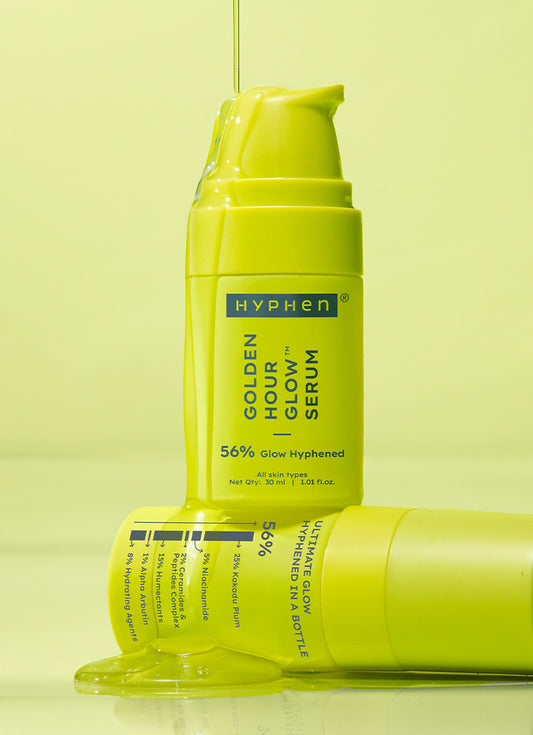
For example, Hyphen's Golden Hour Glow Face Serum contains a 56% complex of active ingredients including Kakadu Plum (a natural source of vitamin C), 5% Niacinamide, Alpha Arbutin, Hyaluronic Acid, Ceramides, and peptides. The formulation is non-comedogenic and lightweight, which makes it suitable for oily and combination skin types. However, like most multi-active serums, it may feel slightly too active for very sensitive skin if introduced too quickly, so gradual use is important. Visible changes in brightness and skin texture typically begin to appear after 4 to 6 weeks of consistent use.

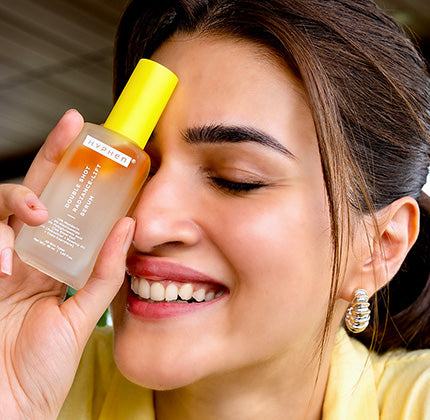
If deeper pigmentation and early signs of skin laxity are concerns, Hyphen's Double Shot Radiance Lift Serum uses a higher-strength formulation with an 18% brightening complex and a 20% collagen complex. Due to its potency, it may require careful layering with other actives to avoid over-exfoliation or sensitivity.


What Face Serum is Suitable for Beginners in India?

The worst mistake made by beginners is trying to do everything at once. Using three serums, five actives, or changing products every fortnight. This is the surest method to get your skin irritated while you still don't know which ingredients are really working for you. Choosing the right face serum for beginners in India is less about finding the fanciest formula and more about starting with something your skin can actually handle.

As a beginner who wishes to start using serums, start with:

  • One problem at a time - Select the most important one. Moisturization or luminosity is always easier for your skin to cope with first. The problems like pigmentation and acne scars can be handled afterwards when your skin adjusts.

  • A kind formula - The most tolerable ingredients are niacinamide and hyaluronic acid that work well on all Indian skin types, including those with sensitivity and acne issues.

  • Once a day at night - Always start applying the serum at night since the skin isn't battling against any external factor like sunscreen or pollution. Only shift to twice a day (morning and night) after a few weeks of usage.

  • Everything else should be kept as simple as possible - Cleanser, serum, moisturiser, sunscreen. That's it to begin with. You cannot possibly tell what is working and what is not when you pile too many things on your face at once.

  • Do not change your products in the middle - It happens way too often that serums don't work because people give up on them halfway through the second week. It takes from 4 to 6 weeks of consistent use to see the real results.

Consistency is much more important than complexity in this case. Using one serum every single day will do better wonders to your skin than five different products applied sporadically.


FAQ

1. How to apply face serum daily without irritation? Place 2-3 drops of serum on slightly damp skin and pat it in lightly instead of rubbing. Begin by using it once daily in the evening and only then increase the usage to twice daily after 2-3 weeks of use. Try out any new serum on a patch of skin behind your ear first.

2. Can I do without moisturiser once I apply the serum? Not at all, and this is something many people don't know about serums. A serum works on your skin but doesn't lock it down. Your moisturiser does that and also ensures that everything remains where it should. Without the moisturiser, especially in dry conditions or air conditioning, your skin would remain exposed.

3. How soon will I notice results from using a face serum? If you use a high-quality hyaluronic acid serum, hydration and plumping could become visible as soon as within a few days. However, for issues such as pigmentation, tanning, and improvement in skin texture, four to six weeks should be enough to notice a difference.

4. Which serum should I start off with as a beginner in India? If you're starting out, a niacinamide or hyaluronic acid serum would be the best choice. They are gentle, effective, and work well on Indian skin, which has issues related to dehydration, oiliness, dullness, and even early signs of pigmentation.

5. Do I have to use serum in the summer season in India? Indeed. If anything, summer is the time that calls for serum application in India. With its light texture, serum does not make your skin even more oily than it already is in the hot and humid weather. An oil-based solution would seem quite unnecessary in such conditions.

6. Does using serum become mandatory when creating a skincare regimen? No, if your regimen is working just fine for you. However, if you happen to experience some problems related to your skin condition, say, if you have some pigmentation, tanning issues or just want to restore the glow of your skin that has been drained by the harsh Indian climate, a serum will definitely help.

7. Can I use two serums at once? You technically can, but it is better not to if you are just starting out. Until you understand what works well with your skin type and what causes negative reactions, using two active components is a bit reckless. Start with trying only one.


Back to blog