HYPHEN DIARIES

Skincare serum bottles on a warm neutral surface with ingredient labels facing forward, representing reading the label over the brand name

Indian vs International Serums: Is It the Ingredient or the Name?

Short answer: No, an international serum is not automatically better than an Indian one. What decides whether a serum works is on the label, not on the flag - the named active, its concentration, how stable the formulation is, and whether it has been clinically or in-vivo tested. A higher price often pays for brand prestige and import margins, not better chemistry. Read the label, not the country: a clinically tested Indian serum like Hyphen's 10% Vitamin C Serum with 1% Vitamin E and Ferulic Acid (₹575), Double Shot Radiance Lift Face Serum (18% Brightening Complex + 20% Collagen Complex, ₹649) or Dual Phase De-pigmentation Serum with 4% Tranexamic Acid (₹599) can hold its own against far pricier names on the only things that matter.

Table of Contents

Does the country of origin decide whether a serum works?

It is a fair instinct to assume an imported serum, with its higher price and polished packaging, must be doing something an Indian one cannot. But skincare actives are not patriotic. Niacinamide, vitamin C, tranexamic acid and the rest are the same molecules whether they are blended in Mumbai, Seoul, Paris or New York. Your skin reads chemistry, not the address on the box.

The country of origin tells you almost nothing about how a serum will perform. What it can quietly add is cost - import duties, currency conversion, distribution layers and a premium for the name on the front. None of that reaches your skin. So before you decide an international serum is the better buy, it helps to turn the bottle around and read what is actually inside, because that is the only part your skin responds to.

How to read a serum label: the four things that actually matter

A serum is only as good as four things, and all of them are printed on the label or backed by the brand's testing - not by where it was made or what it costs. Run any serum, Indian or international, through this checklist:

  • The named active. A vague "brightening blend" or "advanced complex" with no named ingredient is a marketing phrase, not a formulation you can judge.
  • Its concentration. The same active at 2% and at 10% are not the same product. The percentage decides whether there is enough active to do the job.
  • The formulation and stability. A well-chosen active in an unstable formula degrades on the shelf and does little by the time you use it.
  • The testing behind it. Clinical or in-vivo testing is the difference between a claim and evidence.

Get those four right and the serum works. Get them wrong and a luxury price tag will not save it. Let us take them one at a time.

The active and its concentration, not the brand name

The single most useful habit in skincare is reading the active and its percentage off the front of the pack. A named active at a studied concentration is a serum you can reason about. A serum that only promises a result, with no ingredient or percentage to back it, is asking you to trust the brand instead of the chemistry.

Concentration is not a detail - it is often the whole story. Topical vitamin C, for example, needs to clear a real threshold to do anything: a review of topical vitamin C in dermatology notes that a formulation needs a vitamin C concentration above roughly 8% to be biologically meaningful, with the useful range sitting around 10 to 20%. A serum carrying "Vitamin C" on the front at 2% is not a smaller version of a 10% serum - it is below the level that the evidence says matters. The same logic runs through every active. Niacinamide is studied and effective in the 2 to 5% range for pigmentation and barrier support. Topical tranexamic acid is studied for melasma across roughly 0.5 to 5%. An imported serum at a token percentage is not better than an Indian serum at a studied one. It is worse, regardless of the price.

Formulation and stability: where many serums quietly fail

A good active in a bad formula is wasted money, and this is where a lot of expensive serums quietly let you down. Vitamin C is the clearest example. In its most common form, L-ascorbic acid is highly unstable and oxidises when exposed to air, and many products do not penetrate the skin well enough to make a difference - which is exactly why DermNet notes that poorly formulated vitamin C can be effectively useless on the skin no matter what the label promises.

Stability is solved by formulation, not by prestige. The classic fix for vitamin C is to pair it with vitamin E and ferulic acid: a landmark study found that adding ferulic acid to a solution of vitamins C and E stabilised the formula and roughly doubled its photoprotection. That is a chemistry decision any brand can make, in any country, at any price point. Other formats solve other problems - a dual-phase serum keeps two reactive systems apart in the bottle and combines them only when you shake it, protecting the active until the moment you use it. When you compare two serums, the question is not which brand is more famous. It is which one has been formulated to actually keep its active alive and working until it reaches your skin.

Clinical and in-vivo testing: the proof, not the promise

The last thing on the checklist is evidence. A claim like "visibly brighter skin" means very little on its own. What gives it weight is testing - ideally clinical or in-vivo testing, where the finished product is assessed on real skin rather than only in theory. This is the part marketing cannot fake and a high price cannot buy.

An imported serum with a beautiful claim and no testing behind it is a promise. An Indian serum that has been clinically or in-vivo tested is a result you can lean on. When two serums name the same active at the same concentration, testing is the tie-breaker - and it is one of the few label signals that genuinely separates a serious formulation from a pretty bottle.

Hyphen 10% Vitamin C Serum with 1% Vitamin E and Ferulic Acid

Hyphen 10% Vitamin C Serum with 1% Vitamin E and Ferulic Acid 20ml, in-vivo tested antioxidant brightening serum
10% Vitamin C Serum with 1% Vitamin E and Ferulic Acid - ₹575, antioxidant brightening and daily defence.

Price: ₹575 · Hero active: 10% Vitamin C as 3-O ethyl ascorbic acid, with a 1% antioxidant blend of Vitamin E, Ferulic Acid, CoQ10 and EGCG

Run this serum through the checklist and it reads well on every line. The active is named and dosed on the front: 10% vitamin C, here as 3-O ethyl ascorbic acid, a more stable form than the pure L-ascorbic acid that oxidises so easily. That stable derivative is held steady by a 1% antioxidant blend and a low pH, in a sustained-release formula that keeps delivering antioxidant protection for up to 12 hours, with heartleaf extract and allantoin to keep it gentle on sensitive skin. And it is in-vivo tested, so the brightening claim is backed by assessment on real skin. It works as a daily antioxidant and brightening serum, helping fade acne marks and defend against everyday UV and environmental damage, and it is beginner-friendly across all skin types with results typically over 4 to 6 weeks. Avoid layering it with strong exfoliants in the same routine. Clinically tested, fragrance free, 100% vegan and PETA certified.

Best for: antioxidant brightening, fading acne marks, and daily environmental defence.

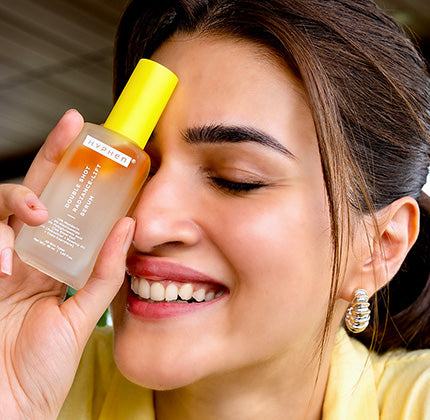
Hyphen Double Shot Radiance Lift Face Serum (18% Brightening Complex + 20% Collagen Complex)

Hyphen Double Shot Radiance Lift Face Serum 50ml with an 18% Brightening Complex and 20% Collagen Complex for daily brightening and firmness
Double Shot Radiance Lift Face Serum - 18% Brightening Complex and 20% Collagen Complex, ₹649, daily brightening and firmness.

Price: ₹649 · Hero actives: 18% Brightening Complex (11% Mandarin Vitamin C + 5% Niacinamide + 2% Polyglutamic Acid) plus a 20% Collagen Complex

The same checklist holds up here, and the label spells out every active with its percentage. The 18% brightening complex is 11% mandarin extract, a natural source of vitamin C that brightens and fights free radicals, 5% niacinamide, which evens tone and supports the skin barrier, and 2% polyglutamic acid for deep hydration. Paired with it is a 20% collagen complex of bakuchiol, a gentler plant alternative to retinol, with rosehip oil and coco-caprylate for firmness and better absorption. It is a dual-phase serum, so you shake it before use to combine the water and oil phases, and it can be used morning or night for visibly brighter, more even and firmer-looking skin over 4 to 6 weeks. Clinically tested, fragrance free, 100% vegan and PETA certified.

Best for: daily glow, early-stage unevenness, and a brightening plus firmness boost.

Hyphen Dual Phase De-pigmentation Serum (4% Tranexamic Acid)

Hyphen Dual Phase De-pigmentation Serum 30ml with 4% tranexamic acid and niacinamide, in-vivo tested for melasma and dark spots
Dual Phase De-pigmentation Serum - 4% Tranexamic Acid with niacinamide, ₹599, targeted pigmentation correction.

Price: ₹599 · Corrective phase: 4% Tranexamic Acid + 5% Niacinamide + Vitamin B12 · Preventive phase: 4-Butylresorcinol + Licorice

This is the targeted option, and it is a good demonstration of why concentration and format earn their place on the label. Its dual-phase format splits the work across two layers you shake together before use. The water, corrective phase pairs 4% tranexamic acid - which sits inside the 0.5 to 5% band studied for melasma - with 5% niacinamide and vitamin B12 to correct existing dark spots, melasma and post-acne marks, reducing melanin at the source and limiting its transfer to the skin's surface. The oil, preventive phase uses 4-butylresorcinol and licorice to prevent new pigmentation from forming by inhibiting tyrosinase, the enzyme that drives melanin production. So one phase clears what is already there while the other slows the next round, and keeping the two apart in the bottle holds the actives stable until use. It is in-vivo tested. Because it is a stronger, targeted treatment, start slowly at about twice a week and build up, use it morning or night with daily sunscreen, and avoid pairing it in the same routine as retinol, vitamin C or AHA and BHA exfoliants. Clinically tested, fragrance free, 100% vegan and PETA certified.

Best for: stubborn pigmentation, melasma and post-acne marks.

So, ingredient or name?

Ingredient, every time. The name on the front and the country on the back are the two things your skin never sees. What it does respond to is the molecule, its concentration, the stability of the formula and the evidence behind it - and all four of those are visible on the label or in the brand's testing, whatever the price. A clinically and in-vivo tested Indian serum that names a studied active at a studied concentration is not a compromise against an imported one. It is the same chemistry, judged on the same terms, often without the prestige markup. Read the label, not the flag, and explore the full Hyphen serum range on the things that genuinely decide results.

Frequently Asked Questions

Q: Are international serums better than Indian serums?
A: Not by default. A serum works because of its named active, that active's concentration, how stable the formulation is, and whether it has been clinically or in-vivo tested - none of which depend on the country of origin. A higher import price often pays for prestige and distribution rather than better chemistry. A clinically tested Indian serum that names a studied active at a studied concentration can perform on par with a far pricier imported one.

Q: How do I read a serum label to judge if it actually works?
A: Check four things. First, is the active named, or is it hidden behind a vague "complex"? Second, is the concentration stated, and is it at a studied level - for example, vitamin C above roughly 8%, niacinamide around 2 to 5%, tranexamic acid around 0.5 to 5%? Third, is the formulation built to keep that active stable? Fourth, is there clinical or in-vivo testing behind the claims? If all four check out, the serum is worth your money regardless of the brand.

Q: Does a higher price mean a better serum?
A: No. Most skincare actives are widely available commodity ingredients, so a higher price often reflects brand prestige, packaging, marketing and import costs rather than a more effective formula. A reasonably priced serum with a named active at a studied concentration, in a stable formulation and with testing behind it, can outperform a luxury serum that gets those basics wrong.

Q: Why does the concentration of an active matter so much?
A: Because below a certain level, an active simply does not do enough. Topical vitamin C, for instance, generally needs to be above roughly 8% to be biologically meaningful, so a serum carrying "Vitamin C" at 2% is below the threshold the evidence supports. The named active tells you what the serum is trying to do, and the concentration tells you whether it can.

Q: What does clinically tested or in-vivo tested mean on a serum?
A: In-vivo testing means the finished product was assessed on real skin rather than only in theory or on lab models, and clinical testing means it was evaluated in a structured study. Both turn a claim into evidence. When two serums name the same active at the same concentration, testing is the signal that one has done the work to show the formula actually performs.

Q: Which Hyphen serum should I choose?
A: It depends on your concern. For antioxidant brightening and daily UV defence, the 10% Vitamin C Serum with 1% Vitamin E and Ferulic Acid (₹575) is the daily pick. For everyday glow, early unevenness and a firmness boost, the Double Shot Radiance Lift Face Serum (18% Brightening Complex + 20% Collagen Complex, ₹649) suits most skin. For stubborn pigmentation, melasma or post-acne marks, the Dual Phase De-pigmentation Serum (4% Tranexamic Acid, ₹599) is the targeted treatment. All three are clinically and in-vivo tested, fragrance free, 100% vegan and PETA certified.

Sources

A quick note

This article is published by Hyphen on Hyphen Diaries and references Hyphen's own products. It's general information, not medical advice. Skincare results vary with skin type and consistency - most actives need at least four weeks of regular use before you judge them. Patch-test any new product, and see a qualified dermatologist for persistent pigmentation, melasma or any severe skin concern.

Part of Hyphen Diaries. Products mentioned are formulated for Indian skin and humid climates. All formulations are Clinically Tested, PETA Certified, 100% Vegan and Fragrance Free.

Back to blog